
AI Multi-Agent Data Lake
Governance
Recklabs designed and deployed an autonomous multi-agent data governance platform on AWS, enabling Fix-it.ai to automate data discovery, classification, PII/PHI detection, quality validation, and policy enforcement across their enterprise data lake.
About the Customer
Fix-it.ai operates a large-scale AWS data lake environment spanning multiple business units and data domains. Their data engineering and governance teams manage hundreds of S3 buckets and data catalog entries, with petabytes of data flowing in daily from diverse sources.
| Customer | Fix-it.ai |
| Industry | Data Management / Cloud Analytics |
| Market Segment | Enterprise |
| Case Study Type | Public |
Key Business Challenges
- Ungoverned data proliferation caused data engineers to waste significant time searching for reliable datasets, increasing risk of analytics based on stale or incorrect data.
- Manual classification processes required stewards to review datasets individually, resulting in incomplete metadata coverage and slow onboarding of new data sources.
- PII and PHI detection was performed manually and inconsistently, delaying compliance certification and increasing regulatory exposure.
- Access control policies were applied reactively rather than proactively, resulting in over-permissioned roles and potential data leakage.
- Data quality validation was fragmented across teams, with no unified scoring or continuous monitoring.
Project Goals & Objectives
- Automate data governance across the enterprise data lake.
- Improve data quality scores and ensure analytics reliability.
- Protect sensitive information (PII/PHI) and enforce compliance.
- Maintain complete metadata and data lineage for auditability.
- Reduce manual governance effort by 80%.
- Enable consistent, audit-ready governance documentation.
Solution Overview
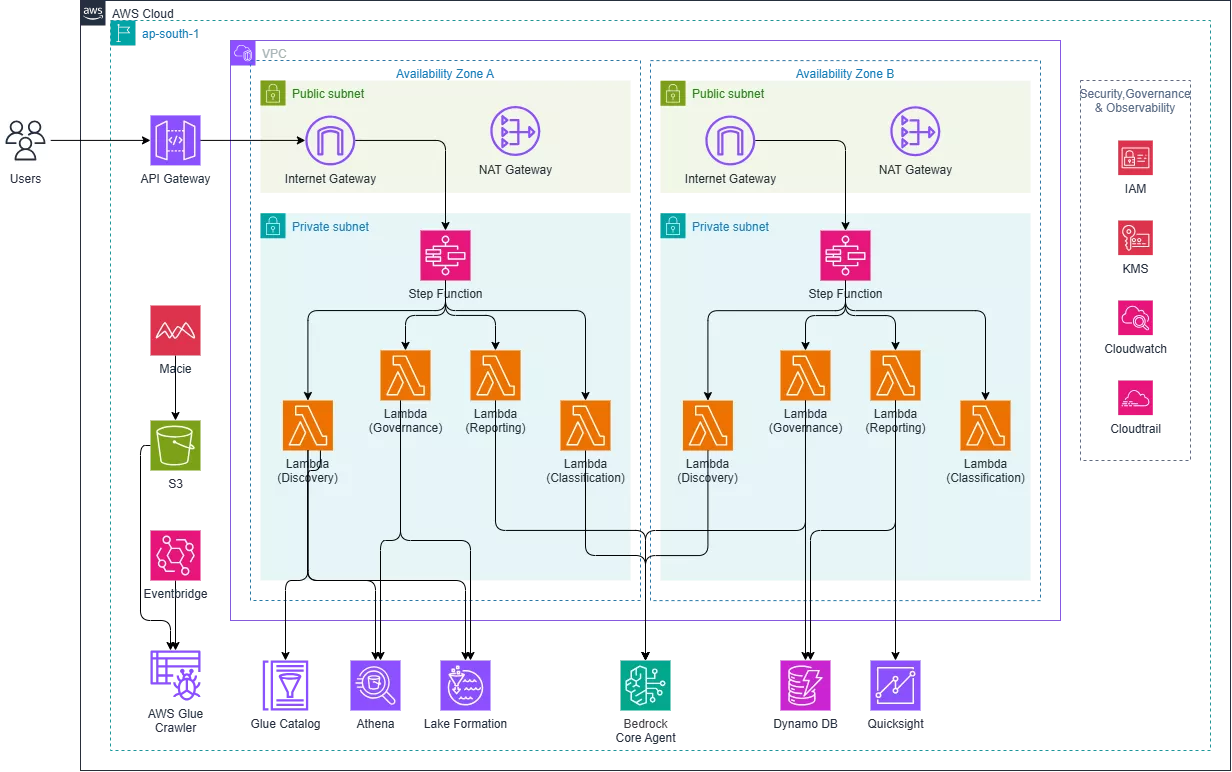
An Agentic AI Multi-Agent Data Lake Governance platform was built on Amazon Bedrock Agents to automate data discovery, classification, PII detection, quality validation, policy enforcement, and reporting workflows. An Orchestrator Agent coordinates all specialized agents using AWS Step Functions.
Multi-Agent Architecture — 8 Specialized Agents
Discovery Agent
Discovers new datasets, schema changes, and data source registrations across S3 buckets and Glue Data Catalog.
Classification Agent
Classifies data by type, domain, and sensitivity level using AI-based content analysis and metadata inference.
PII Detection Agent
Scans for PII, PHI, and sensitive data patterns using Amazon Macie and Amazon Bedrock reasoning capabilities.
Metadata & Lineage Agent
Updates the data catalog with enriched metadata and tracks data lineage across transformations and pipelines.
Quality Agent
Validates data quality rules, scores datasets, and identifies anomalies using AWS Glue Data Quality and Athena.
Policy Enforcement Agent
Applies and enforces access control policies using Lake Formation and IAM, with human approval for critical changes.
Recommendation Agent
Generates optimization recommendations for storage, partitioning, retention, and governance improvements.
Reporting Agent
Creates governance dashboards, compliance reports, and executive summaries using QuickSight and Bedrock.
AWS Services Used
Security & Responsible AI
Security & Account Governance
- IAM least-privilege access across all governance agents
- AWS KMS customer-managed encryption keys
- CloudTrail for comprehensive audit logging
- Lake Formation fine-grained access at column/row level
- Bedrock Guardrails to prevent data exposure
- Private VPC endpoints for all services
Responsible AI Controls
- Decisions based solely on data characteristics and policy rules
- Human approval for critical policy enforcement actions
- Full evidence, reasoning chain, and confidence scores
- Complete audit trail of all agent actions and decisions
- Data isolation across business units
- Bias-free governance recommendations
Architecture — High Availability & Scalability
The platform follows a fully serverless-first architecture optimized for scalability, reliability, and operational efficiency. All critical services operate across multiple Availability Zones with no single point of failure.
Business Outcomes
| KPI | Baseline | Target | Actual Result |
|---|---|---|---|
| Data Quality Score | ~60% coverage | 95% coverage | 97% coverage ✓ |
| Governance Coverage | Manual, ~40% | 95% automated | 98% automated ✓ |
| PII Detection Accuracy | Manual spot checks | 99% detection | 99.2% detection ✓ |
| Policy Compliance | Reactive enforcement | 100% proactive | 100% proactive ✓ |
| Metadata Completeness | ~50% cataloged | 95% completeness | 96% completeness ✓ |